How Much Protein Do I Need a Day? By Your Weight, and Where to Get It
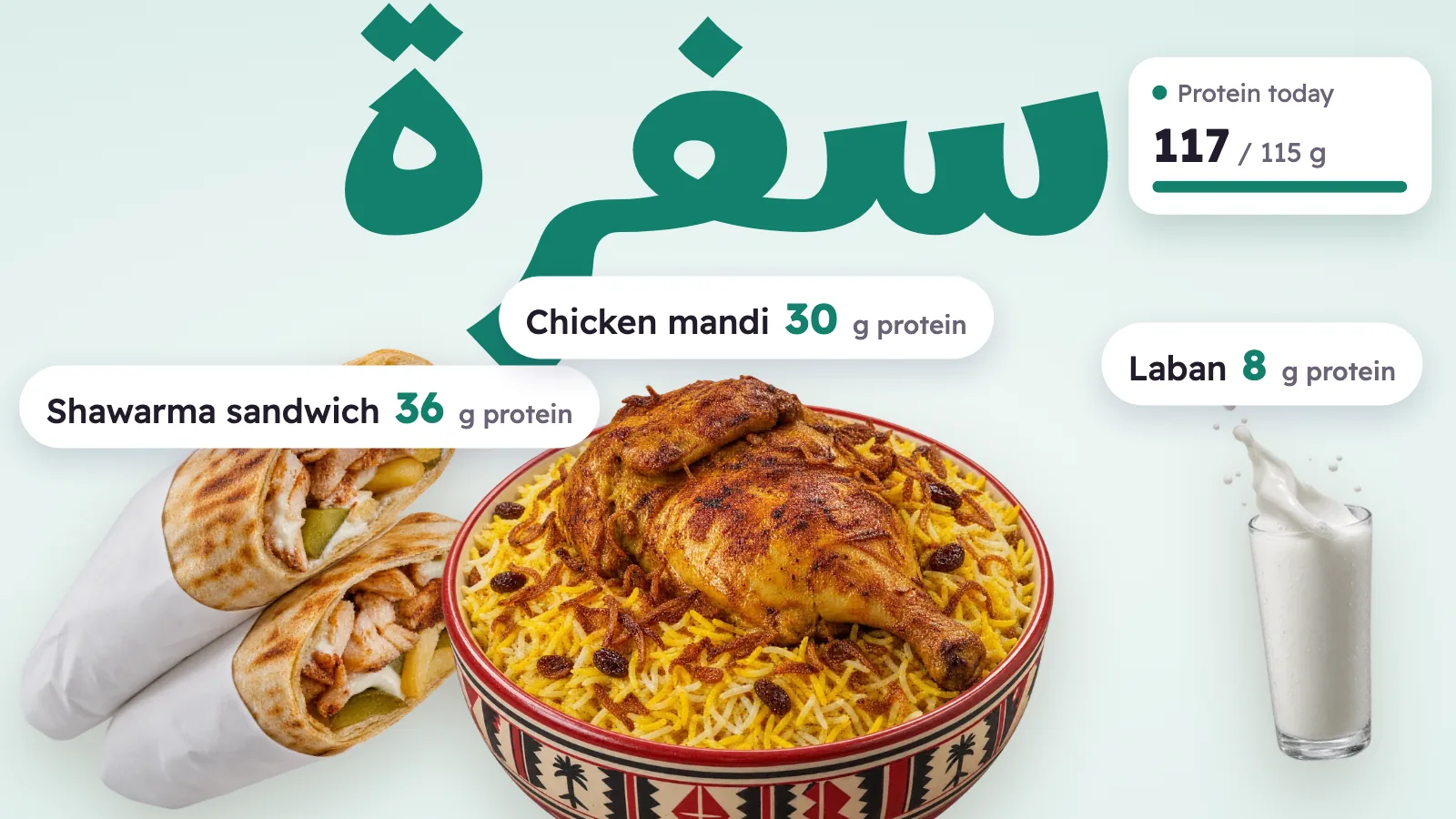
Most adults need at least 0.8 g of protein per kilogram of body weight a day1, which is 56 g for someone who weighs 70 kg (154 lb). If you train regularly and want to build or keep muscle, the suggested range is 1.4 to 2.0 g per kilogram2: 98 to 140 g at the same weight. In Sufra, protein is a quarter of your calorie goal, so a 1,850-calorie goal comes with 115 g of protein.
In pounds: 0.8 g per kilogram is about 0.36 g per pound, and 1.4 to 2.0 g per kilogram is about 0.64 to 0.91 g per pound.
How many grams of protein for your weight?
Multiply your weight in kilograms by the number that fits you:
| You | Per kg of body weight | At 70 kg (154 lb) |
|---|---|---|
| Most adults1 | 0.8 g | 56 g |
| Over 653 | 1.0 to 1.2 g | 70 to 84 g |
| Regular exercise or building muscle2 | 1.4 to 2.0 g | 98 to 140 g |
A review of 49 resistance-training studies found that extra protein stopped adding muscle at about 1.6 g per kilogram a day4; more than that added no more muscle in those studies.
Pregnancy and breastfeeding need more1, and people with severe kidney disease may need less3: in both cases, ask your doctor.
Table: protein by body weight
| Your weight | × 0.8 | × 1.2 | × 1.6 | × 2.0 |
|---|---|---|---|---|
| 50 kg 110 lb | 40 g | 60 g | 80 g | 100 g |
| 60 kg 132 lb | 48 g | 72 g | 96 g | 120 g |
| 70 kg 154 lb | 56 g | 84 g | 112 g | 140 g |
| 80 kg 176 lb | 64 g | 96 g | 128 g | 160 g |
| 90 kg 198 lb | 72 g | 108 g | 144 g | 180 g |
| 100 kg 220 lb | 80 g | 120 g | 160 g | 200 g |
The first column is the minimum for most adults; the others are for people over 65 or who train regularly.
How Sufra sets your protein
Sufra splits your calorie goal into 25% protein, 45% carbs and 30% fat (how the goal is worked out is in How many calories do I need a day?). Each gram of protein has 4 calories, so a 1,850-calorie goal comes with 1,850 × 25% ÷ 4 ≈ 115 g of protein. For a man who weighs 82.4 kg (182 lb), that is about 1.4 g per kilogram, inside the range suggested for people who train.
How much protein is in our food?
Every number is for a set amount in grams, from Sufra's food table with its source.
Meat, chicken and fish
A skinless chicken breast (86 g) has 27 g of protein for only 142 calories, and a can of tuna in water 41 g for 220. They are among the highest in protein for their calories.
| Dish | Portion | Protein | Calories |
|---|---|---|---|
| Roast chicken breast, skinless5 | breast (86 g) | 27 g | 142 |
| Roast chicken6 | quarter chicken (150 g) | 41 g | 358 |
| Shish tawook with vegetables7 | skewer (202 g) | 26 g | 210 |
| Chicken shawarma meat, no bread8 | 100 g | 30 g | 197 |
| Lamb, cooked9 | piece (85 g) | 21 g | 250 |
| Ground beef, cooked10 | serving (85 g) | 21 g | 204 |
| Liver, pan-fried11 | serving (85 g) | 23 g | 149 |
| Tuna in water12 | can (172 g) | 41 g | 220 |
| Salmon13 | fillet (178 g) | 39 g | 367 |
| Shrimp14 | serving (85 g) | 20 g | 84 |
Arabic dishes
A medium plate of lamb mandi has 43 g of protein, a chicken shawarma sandwich 36 and a medium plate of chicken kabsa 33. That is a lot of protein, but it comes with more calories: 803, 491 and 529.
| Dish | Portion | Protein | Calories |
|---|---|---|---|
| Lamb mandi15 | medium plate (400 g) | 43 g | 803 |
| Chicken shawarma sandwich16 | sandwich (182 g) | 36 g | 491 |
| Chicken kabsa17 | medium plate (400 g) | 33 g | 529 |
| Chicken threed18 | medium plate (300 g) | 23 g | 302 |
| Sayadiyah (fish and rice)19 | medium plate (400 g) | 38 g | 690 |
| Madoos (rice with lentils)19 | medium plate (400 g) | 16 g | 505 |
| Mutabbaq (egg)19 | piece (200 g) | 14 g | 313 |
| Falafel sandwich20 | sandwich (215 g) | 13 g | 570 |
| Lentil soup21 | bowl (255 g) | 10 g | 153 |
Eggs and dairy
A boiled egg has 6 g of protein and a pot of Greek yogurt 15, more than twice plain yogurt (7). A glass of laban has 8.
| Dish | Portion | Protein | Calories |
|---|---|---|---|
| Boiled egg22 | egg (50 g) | 6 g | 78 |
| Greek yogurt, plain23 | pot (170 g) | 15 g | 162 |
| Plain yogurt, whole milk24 | pot (170 g) | 7 g | 131 |
| Laban25 | cup (249 g) | 8 g | 99 |
| Milk (whole)26 | cup (248 g) | 8 g | 151 |
Beans, lentils and nuts
A cup of boiled lentils has 18 g of protein and a cup of boiled chickpeas 15. A small plate of foul has 7, about the same as a small plate of hummus.
| Dish | Portion | Protein | Calories |
|---|---|---|---|
| Lentils, boiled27 | cup (198 g) | 18 g | 230 |
| Chickpeas, boiled28 | cup (164 g) | 15 g | 269 |
| Fava beans, boiled29 | cup (170 g) | 13 g | 187 |
| Foul medames30 | small plate (138 g) | 7 g | 225 |
| Hummus31 | small plate (100 g) | 7 g | 229 |
| Almonds32 | handful (23 almonds) | 6 g | 164 |
| Peanuts, roasted, salted33 | handful (1 oz) | 7 g | 167 |
Example: a day with 117 g of protein from Arabic food
A day with numbers from the tables above, under a 1,850-calorie goal:
| Meal | What's in it | Protein | Calories |
|---|---|---|---|
| Breakfast | 2 boiled eggs, a small plate of foul, a loaf of Arabic bread | 25 g | 545 |
| Lunch | A medium plate of chicken kabsa, a glass of laban | 41 g | 628 |
| Snack | A pot of Greek yogurt | 15 g | 162 |
| Dinner | A skewer of shish tawook with vegetables, a bowl of lentil soup | 36 g | 363 |
| Total | 117 g | 1,698 |
That's 117 g of protein for 1,698 calories. Notice the spread: 20 to 40 g at each main meal, close to the per-meal amount the International Society of Sports Nutrition suggests2.
Frequently asked questions
How much protein do I need for my weight?
Multiply your weight in kilograms by 0.8 for the minimum, or by 1.4 to 2.0 if you train regularly. For example, at 60 kg (132 lb): at least 48 g, and 84 to 120 g with training. At 80 kg (176 lb): at least 64 g, and 112 to 160 g with training.
How much protein is in an egg?
A boiled egg (50 g) has about 6 g of protein and 78 calories; two eggs have about 13 g.
How much protein is in a chicken breast?
A roast chicken breast without skin (86 g) has about 27 g of protein and 142 calories, which is 31 g of protein per 100 g.
How much protein do I need to build muscle?
With resistance training, the suggested range is 1.4 to 2.0 g per kilogram a day (about 0.64 to 0.91 g per pound), spread over meals at 20 to 40 g each. A review of 49 studies found that extra protein stopped adding muscle at about 1.6 g per kilogram.
Do I need protein shakes?
Not necessarily. The example day in this article has 117 g of protein from regular food. If you want something quick, a ready-to-drink protein shake (330 ml) has about 24 g of protein and 218 calories.
Is too much protein bad for you?
The suggested amounts for people who train go up to 2.0 g per kilogram a day. People with severe kidney disease may need to eat less protein, so if you have any kidney condition, ask your doctor before you raise it.
This is general information, not medical advice, and every number is an estimate. If you have a health condition, ask your doctor or a dietitian before you change how you eat.
Sources
36 sources
- Dietary Reference Intakes for Energy, Carbohydrate, Fiber, Fat, Fatty Acids, Cholesterol, Protein, and Amino Acids (2005) · National Academies
- Jäger R, et al. International Society of Sports Nutrition Position Stand: protein and exercise. J Int Soc Sports Nutr 2017;14:20 · Journal of the International Society of Sports Nutrition
- Bauer J, et al. Evidence-based recommendations for optimal dietary protein intake in older people: a position paper from the PROT-AGE Study Group. J Am Med Dir Assoc 2013;14(8):542–559 · JAMDA
- Morton RW, et al. A systematic review, meta-analysis and meta-regression of the effect of protein supplementation on resistance training-induced gains in muscle mass and strength in healthy adults. Br J Sports Med 2018;52(6):376–384 · PubMed
- Chicken, broilers or fryers, breast, meat only, cooked, roasted (FDC 171477, SR Legacy) · USDA FoodData Central
- Chicken, broilers or fryers, meat and skin, cooked, roasted (FDC 171450, SR Legacy) · USDA FoodData Central
- Chicken or turkey shish kabob with vegetables, excluding potatoes (FDC 2706783, Survey (FNDDS)) · USDA FoodData Central
- Development of a Lebanese food exchange system based on frequently consumed Eastern Mediterranean traditional dishes and Arabic sweets (Hoteit M, Zoghbi E, Rady A, Shankiti I, Al-Jawaldeh A; F1000Research 2021, 10:12, doi:10.12688/f1000research.27461.1)
- Lamb, composite of trimmed retail cuts, separable lean and fat, trimmed to 1/4" fat, choice, cooked (FDC 172480, SR Legacy) · USDA FoodData Central
- Beef, ground, unspecified fat content, cooked (FDC 172161, SR Legacy) · USDA FoodData Central
- Beef, variety meats and by-products, liver, cooked, pan-fried (FDC 168627, SR Legacy) · USDA FoodData Central
- Fish, tuna, white, canned in water, drained solids (FDC 175158, SR Legacy) · USDA FoodData Central
- Fish, salmon, Atlantic, farmed, cooked, dry heat (FDC 175168, SR Legacy) · USDA FoodData Central
- Crustaceans, shrimp, cooked (FDC 175180, SR Legacy) · USDA FoodData Central
- Fall Apart Lamb Mandi (Hungry Paprikas)
- شاورما بالخبز العربي (أطيب طبخة) · Atyab Tabkha
- Chicken Kabsa (Munaty Cooking)
- The effect of nutritional composition on the glycemic index and glycemic load values of selected Emirati foods (Al Dhaheri AS, Al Ma'awali AK, Laleye LC, Washi SA, Jarrar AH, Al Meqbaali FT, Mohamad MN, Masuadi EM; BMC Nutrition 2015, 1:4, doi:10.1186/2055-0928-1-4)
- Comprehensive nutritional compositions of traditional dishes from five Saudi regions using ESHA Food Processor software (Basaqr R, Bakr E-S, Ibrahim Y, Bujan Y, Alqasimi K, Aljaadi A; Front Nutr 2025, doi:10.3389/fnut.2025.1658078) · Frontiers in Nutrition (PMC12641437)
- Falafel sandwich (FDC 2707483, Survey (FNDDS)) · USDA FoodData Central
- Soup, lentil (FDC 2707462, Survey (FNDDS)) · USDA FoodData Central
- Egg, whole, cooked, hard-boiled (FDC 173424, SR Legacy) · USDA FoodData Central
- Yogurt, Greek, plain, whole milk (FDC 2259794, Foundation) · USDA FoodData Central
- Yogurt, plain, whole milk (FDC 2259793, Foundation) · USDA FoodData Central
- Milk, buttermilk, fluid, cultured, lowfat (FDC 170874, SR Legacy) · USDA FoodData Central
- Milk, whole, 3.25% milkfat, with added vitamin D (FDC 171265, SR Legacy) · USDA FoodData Central
- Lentils, mature seeds, cooked, boiled, without salt (FDC 172421, SR Legacy) · USDA FoodData Central
- Chickpeas (garbanzo beans, bengal gram), mature seeds, cooked, boiled, without salt (FDC 173757, SR Legacy) · USDA FoodData Central
- Broadbeans (fava beans), mature seeds, cooked, boiled, without salt (FDC 173753, SR Legacy) · USDA FoodData Central
- Foul Mudammas Yemeni Style (Qulaba) (Munaty Cooking)
- Hummus, commercial (FDC 321358, Foundation) · USDA FoodData Central
- Nuts, almonds (FDC 170567, SR Legacy) · USDA FoodData Central
- Peanuts, all types, dry-roasted, with salt (FDC 174262, SR Legacy) · USDA FoodData Central
- Bread, pita, white, enriched (FDC 174915, SR Legacy) · USDA FoodData Central
- Nutritional drink or shake, high protein, ready-to-drink, NFS (FDC 2710726, Survey (FNDDS)) · USDA FoodData Central
- Chicken Mandi (K&N's Smart Cooking)