How to Lose Weight in a Healthy Way: 10 Habits Backed by Science
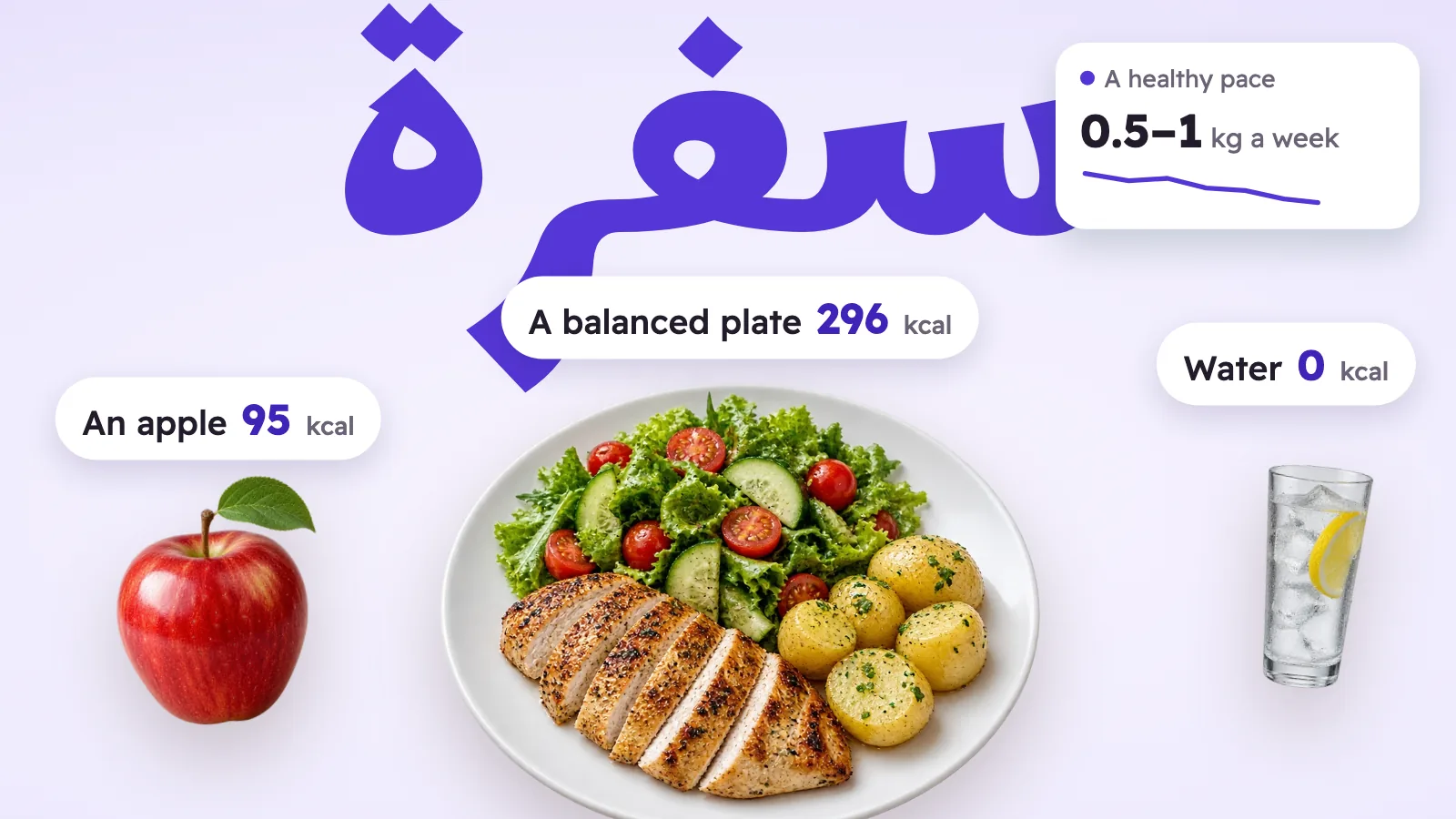
There is no single secret: weight comes down when you eat fewer calories than your body uses, by a gap you can keep up. A safe pace for most people is 0.5 to 1 kg (1 to 2 lb) a week1. These 10 habits help you get there without going hungry or giving up the food you love, each with a study or source behind it.
1. Know your number, and choose a small gap
Your daily need depends on your age, height, weight and activity (the step-by-step math is in How many calories do I need a day?). A gap of 275 to 550 calories a day comes to a quarter to half a kilo (about half a pound to a pound) a week on paper. Don't go below 1,200 calories a day for women or 1,500 for men unless a health professional is guiding you2.
2. Write down what you eat
In a review of 22 studies, people who recorded what they ate, their activity or their weight consistently lost more3, though the review rated the evidence as weak. The reason is simple: writing it down shows you where calories hide, from a spoon of oil to a glass of juice.
3. Put protein in every meal
In controlled studies, higher-protein diets during calorie cutting led to more weight and fat loss and better muscle preservation, and protein is a little more filling4. A chicken breast has 27 g of protein for 142 calories, and a pot of Greek yogurt 15 g. (More in How much protein do I need a day?)
4. Fill half your plate with vegetables and fruit
The World Health Organization advises at least 400 g of vegetables and fruit a day5. They are mostly water and fiber: a plate of green salad is only 36 calories, and an apple 95 with 4.4 g of fiber. (More in Foods that keep you full with fewer calories)
5. Drink water, not calories
In an analysis of 32 studies, each extra daily serving of sugary drinks was linked to weight gain over time in adults6. Drinks also don't fill you up the way food does. Compare:
| Dish | Portion | Calories | Protein |
|---|---|---|---|
| Cola7 | can (330 ml) | 144 | 0 g |
| Orange juice, fresh8 | cup (252 g) | 113 | 2 g |
| Apple juice9 | cup (252 g) | 116 | 0 g |
| Spanish latte10 | medium cup (370 g) | 339 | 12 g |
| Café mocha11 | medium cup (367 g) | 235 | 9 g |
| Latte12 | medium cup (355 g) | 153 | 10 g |
| Cappuccino13 | medium cup (355 g) | 96 | 6 g |
| Black coffee (brewed / americano)14 | medium cup (351 g) | 4 | 0 g |
| Tea, no sugar15 | cup (240 g) | 2 | 0 g |
| Diet cola16 | can (330 ml) | 7 | 0 g |
A medium Spanish latte has 339 calories, more than a chicken breast with a boiled potato (260). Water, black coffee and unsweetened tea have almost none.
6. Eat fewer ultra-processed foods
In a US National Institutes of Health study, 20 adults lived at the clinic for a month: two weeks on ultra-processed food and two weeks on minimally processed food, with the same calories, sugar, fat and fiber on offer. On the ultra-processed diet they ate about 500 calories a day more, and ate faster17. Chips, cookies and packaged pastries are easy to eat and not very filling.
7. Move more, with some strength training
The World Health Organization advises adults to get 150 to 300 minutes a week of moderate activity such as brisk walking, plus muscle-strengthening on two or more days18. Movement alone burns relatively few calories, but it keeps your muscle and health, and makes the rest easier to keep up.
8. Get enough sleep
In a trial with 80 adults with overweight who slept less than six and a half hours, one sleep-coaching session added about 1.2 hours of sleep a night, and they ate about 270 calories a day less than the control group19.
9. Watch the trend, not one day's number
The scale moves every day with water and salt, so weigh at the same time (in the morning, after the bathroom) and compare weeks, not days. As your weight comes down your body uses less energy, so the change slows over time20: update your weight in your plan now and then. (If you stall, read Why am I not losing weight?)
10. Don't ban the food you love
A plan you can keep beats a perfect plan you drop after two weeks. A croissant has 231 calories: it fits in your day when you count it, instead of becoming a "slip" that ruins the week.
When to ask your doctor first
If you are pregnant or breastfeeding, have diabetes or another long-term condition, have a history of eating disorders, are under 18, or take medicines that affect weight, ask your doctor before any diet. In these cases Sufra gives you a maintenance plan with no deficit.
Frequently asked questions
How much weight can I lose a week in a healthy way?
For most people, 0.5 to 1 kg (1 to 2 lb) a week. The first week or two can be faster because part of it is water, then it settles. In Sufra you choose a quarter, half or three quarters of a kilo a week.
Can I lose weight without exercise?
Yes. What decides weight loss is the gap between the calories you eat and the calories your body uses. Movement still helps your health, mood and muscle, and the World Health Organization advises adults to get 150 to 300 minutes of moderate activity a week.
Can I lose belly fat only?
No. In one study, six weeks of ab exercises without changing diet did not reduce belly fat. Belly fat goes down as you lose fat overall; ab exercises strengthen the muscle underneath.
Do I have to give up bread and rice?
No. What matters is the total calories in your day. Have a portion that fits your goal and choose whole grains more often: a slice of whole-wheat toast has 1.9 g of fiber and 81 calories.
Why did I lose weight fast in the first week and then slow down?
Early on you lose water along with fat; after that the change is slower and closer to fat alone. As your weight comes down your body also uses less energy, so update your weight in your plan from time to time.
This is general information, not medical advice, and every number is an estimate. If you have a health condition, ask your doctor or a dietitian.
Sources
33 sources
- Obesity: treatment · NHS (UK)
- Calorie counting made easy · Harvard Health Publishing
- Burke LE, Wang J, Sevick MA. Self-monitoring in weight loss: a systematic review of the literature. J Am Diet Assoc 2011;111(1):92–102 · PubMed
- Leidy HJ, et al. The role of protein in weight loss and maintenance. Am J Clin Nutr 2015;101(6):1320S–1329S · PubMed
- Healthy diet (fact sheet) · World Health Organization
- Malik VS, Pan A, Willett WC, Hu FB. Sugar-sweetened beverages and weight gain in children and adults: a systematic review and meta-analysis. Am J Clin Nutr 2013;98(4):1084–1102 · PubMed
- Beverages, carbonated, cola, regular (FDC 174852, SR Legacy) · USDA FoodData Central
- Orange juice, raw (Includes foods for USDA's Food Distribution Program) (FDC 169098, SR Legacy) · USDA FoodData Central
- Apple juice, canned or bottled, unsweetened, with added ascorbic acid (FDC 167771, SR Legacy) · USDA FoodData Central
- Spanish latte (Gulf News)
- Coffee, Cafe Mocha (FDC 2710410, Survey (FNDDS)) · USDA FoodData Central
- Coffee, Latte (FDC 2710386, Survey (FNDDS)) · USDA FoodData Central
- Coffee, Cappuccino (FDC 2710472, Survey (FNDDS)) · USDA FoodData Central
- Beverages, coffee, brewed, prepared with tap water (FDC 171890, SR Legacy) · USDA FoodData Central
- Beverages, tea, black, brewed, prepared with tap water (FDC 173227, SR Legacy) · USDA FoodData Central
- Beverages, carbonated, low calorie, cola or pepper-type, with aspartame, contains caffeine (FDC 175099, SR Legacy) · USDA FoodData Central
- Hall KD, et al. Ultra-processed diets cause excess calorie intake and weight gain: an inpatient randomized controlled trial of ad libitum food intake. Cell Metab 2019;30(1):67–77 · PubMed
- WHO guidelines on physical activity and sedentary behaviour (2020) · World Health Organization
- Tasali E, et al. Effect of sleep extension on objectively assessed energy intake among adults with overweight in real-life settings: a randomized clinical trial. JAMA Intern Med 2022;182(4):365 · JAMA Internal Medicine
- Hall KD, et al. Quantification of the effect of energy imbalance on bodyweight. Lancet 2011;378(9793):826–837 · PubMed
- Vispute SS, et al. The effect of abdominal exercise on abdominal fat. J Strength Cond Res 2011;25(9):2559–2564 · PubMed
- Cereals, oats, regular and quick, unenriched, cooked with water (includes boiling and microwaving), without salt (FDC 173905, SR Legacy) · USDA FoodData Central
- Strawberries, raw (FDC 167762, SR Legacy) · USDA FoodData Central
- Egg, whole, cooked, hard-boiled (FDC 173424, SR Legacy) · USDA FoodData Central
- Chicken, broilers or fryers, breast, meat only, cooked, roasted (FDC 171477, SR Legacy) · USDA FoodData Central
- Potatoes, boiled, cooked in skin, flesh, without salt (FDC 170438, SR Legacy) · USDA FoodData Central
- Lettuce, salad with assorted vegetables including tomatoes and/or carrots, no dressing (FDC 2709822, Survey (FNDDS)) · USDA FoodData Central
- Oil, olive, salad or cooking (FDC 171413, SR Legacy) · USDA FoodData Central
- Apples, raw, with skin (Includes foods for USDA's Food Distribution Program) (FDC 171688, SR Legacy) · USDA FoodData Central
- Yogurt, Greek, plain, whole milk (FDC 2259794, Foundation) · USDA FoodData Central
- Soup, lentil (FDC 2707462, Survey (FNDDS)) · USDA FoodData Central
- Bread, whole-wheat, commercially prepared (FDC 172688, SR Legacy) · USDA FoodData Central
- Croissants, butter (FDC 174987, SR Legacy) · USDA FoodData Central