Why Am I Not Losing Weight? 9 Common Reasons and What to Do
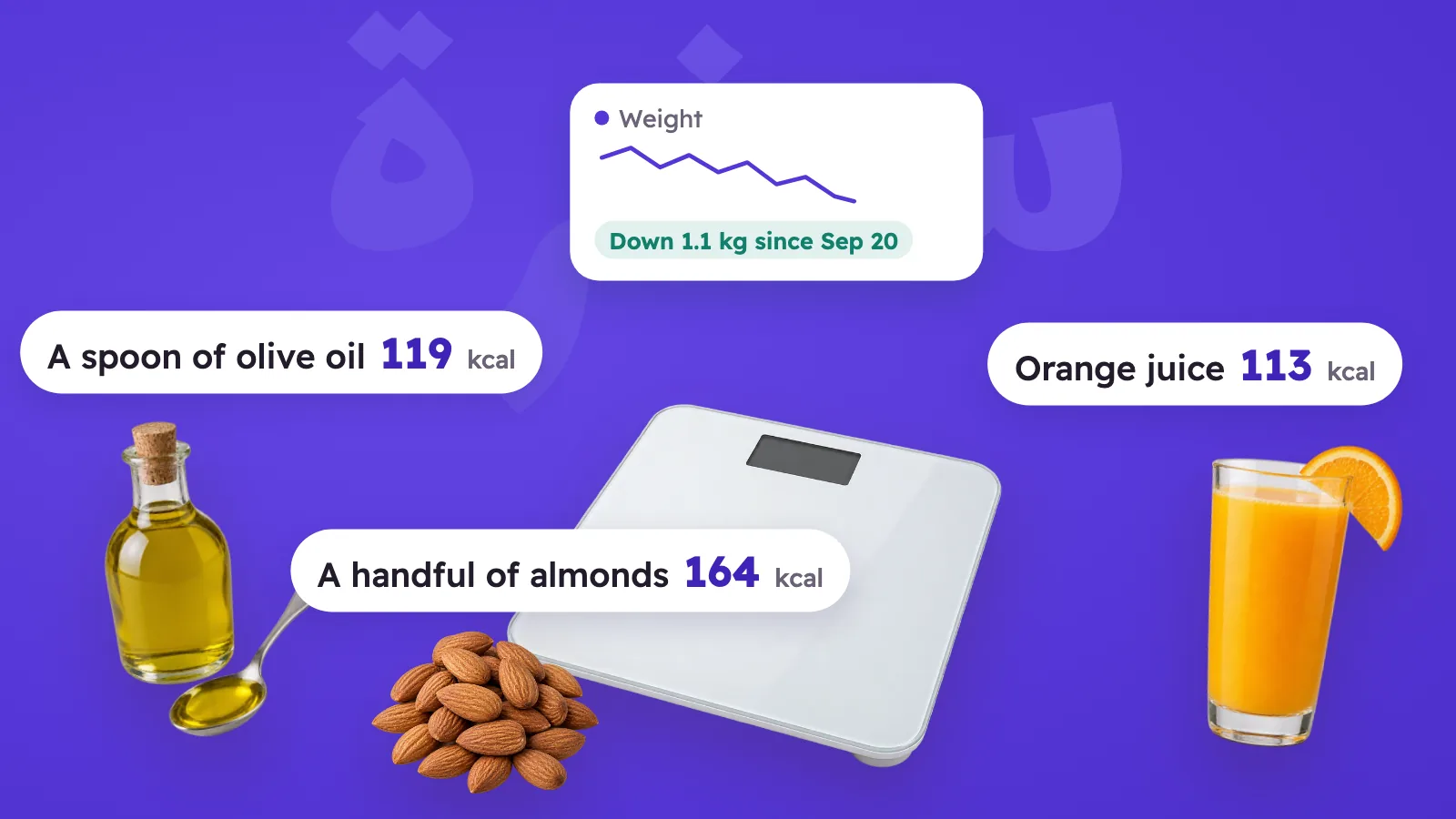
The most common reason is eating more than you write down, without meaning to. In a study of 10 people who said they could not lose weight on a diet, they under-reported what they ate by about 47%, while their metabolism was normal1. The second most common reason is water hiding fat loss on the scale. Here are 9 common reasons for a plateau, and what to do about each.
1. You eat more than you write down
A bite from the kids' plate, a handful of nuts while cooking, dressing on the salad: they are easy to forget. Try logging everything for two weeks, and weigh or measure portions the first few times; you will see where the gap is.
2. Hidden calories in oil, sauces and small bites
A tablespoon of olive oil has 119 calories, so two on a salad add 238. A handful of almonds is 164. Small each time, big over a week:
| Dish | Portion | Calories | Protein |
|---|---|---|---|
| Olive oil2 | tablespoon (14 g) | 119 | 0 g |
| Butter3 | tablespoon (14 g) | 102 | 0 g |
| Tahini4 | tablespoon (15 g) | 89 | 3 g |
| Cream cheese5 | tablespoon (15 g) | 51 | 1 g |
| Cheddar cheese6 | slice (17 g) | 69 | 4 g |
| Almonds7 | handful (23 almonds) | 164 | 6 g |
| Peanuts, roasted, salted8 | handful (1 oz) | 167 | 7 g |
| Honey9 | tablespoon (21 g) | 64 | 0 g |
| Sugar10 | teaspoon (4 g) | 16 | 0 g |
| Spanish latte11 | medium cup (370 g) | 339 | 12 g |
| Orange juice, fresh12 | cup (252 g) | 113 | 2 g |
| Butter croissant13 | medium croissant (57 g) | 231 | 5 g |
| Potato chips14 | small bag (23 g) | 122 | 2 g |
| Chocolate chip cookie15 | cookie (12 g) | 54 | 0 g |
3. Your drinks
A medium Spanish latte has 339 calories, and a glass of orange juice 113. In an analysis of 32 studies, sugary drinks were linked to weight gain over time16. Log them like food, or swap them for water, coffee or tea without sugar.
4. Water weight is hiding fat loss
Your weight can change by up to a kilo (2 lb) from day to day with salt, carbs, your cycle and exercise. So you can be losing fat while the scale stays flat or goes up. Weigh at the same time in the same conditions, and compare one week’s average with the week before.
5. Your body now uses less energy
As your weight comes down your body uses less energy, so the same food that used to bring it down now moves you closer to maintenance17. For example, a 32-year-old man who is 172 cm needs about 2,400 calories at 82.4 kg and 2,300 at 75 kg. Update your weight in your plan and let it work out your number again (the method is in How many calories do I need a day?).
6. The weekend cancels out the week
Five days at 500 calories under = 2,500. Two days at 1,250 over each (a dinner out, dessert, drinks) = 2,500. The result is zero, even though you were on track most of the week. Log weekends like any other day, and plan for them ahead.
7. Too little sleep
In a trial with 80 adults who slept under six and a half hours, sleeping about 1.2 hours longer led them to eat about 270 calories a day less18.
8. You're building muscle
When you start strength training, the scale can hold steady while your waist gets smaller. Measure your waist once a week and notice how your clothes fit, not only the scale.
9. A medical reason or a medicine
Some medicines and some conditions, such as an underactive thyroid, can cause weight gain19. If you have other symptoms or started a new medicine, talk to your doctor.
What to do when your weight stalls
- Log everything for two weeks, drinks, oil and small bites included. In studies, people who tracked their food and weight lost more20.
- Weigh at the same time and compare weekly averages over 2 to 4 weeks.
- Update your weight in your plan so your need is worked out again.
- If you need to, cut 100 to 200 calories more, without going below 1,200 for women or 1,500 for men unless a professional is guiding you21.
- Keep protein and fiber in every meal, sleep enough and move more.
- If nothing changes after a month of accurate logging, talk to your doctor or a dietitian.
For the habits that help from the start, read How to lose weight in a healthy way.
Frequently asked questions
How long does a weight-loss plateau last?
There is no set length. Compare your average weight week to week over 2 to 4 weeks, not day to day. If it has not moved for a full month while you log everything accurately, adjust your plan or talk to a dietitian.
Why did I gain weight when I am eating less?
Most often it is water: a salty meal, more carbs than usual, your period, or a new workout that makes muscles hold water. These change within days, so look at the trend over several weeks.
Should I eat even less when my weight stalls?
First make sure you log everything, oil and drinks included. Then try 100 to 200 calories less, without going below 1,200 a day for women or 1,500 for men unless a health professional is guiding you.
Should I weigh myself every day?
Daily or weekly both work if you compare averages. Weighing yourself regularly is a form of tracking, and in studies tracking was linked to more weight loss.
This is general information, not medical advice, and every number is an estimate. If you have a health condition, ask your doctor or a dietitian.
Sources
21 sources
- Lichtman SW, et al. Discrepancy between self-reported and actual caloric intake and exercise in obese subjects. N Engl J Med 1992;327(27):1893–1898 · PubMed
- Oil, olive, salad or cooking (FDC 171413, SR Legacy) · USDA FoodData Central
- Butter, salted (FDC 173410, SR Legacy) · USDA FoodData Central
- Seeds, sesame butter, tahini, from roasted and toasted kernels (most common type) (FDC 170189, SR Legacy) · USDA FoodData Central
- Cheese, cream (FDC 173418, SR Legacy) · USDA FoodData Central
- Cheese, cheddar (FDC 328637, Foundation) · USDA FoodData Central
- Nuts, almonds (FDC 170567, SR Legacy) · USDA FoodData Central
- Peanuts, all types, dry-roasted, with salt (FDC 174262, SR Legacy) · USDA FoodData Central
- Honey (FDC 169640, SR Legacy) · USDA FoodData Central
- Sugars, granulated (FDC 169655, SR Legacy) · USDA FoodData Central
- Spanish latte (Gulf News)
- Orange juice, raw (Includes foods for USDA's Food Distribution Program) (FDC 169098, SR Legacy) · USDA FoodData Central
- Croissants, butter (FDC 174987, SR Legacy) · USDA FoodData Central
- Snacks, potato chips, plain, salted (FDC 169677, SR Legacy) · USDA FoodData Central
- Cookies, chocolate chip, commercially prepared, soft-type (FDC 172717, SR Legacy) · USDA FoodData Central
- Malik VS, Pan A, Willett WC, Hu FB. Sugar-sweetened beverages and weight gain in children and adults: a systematic review and meta-analysis. Am J Clin Nutr 2013;98(4):1084–1102 · PubMed
- Hall KD, et al. Quantification of the effect of energy imbalance on bodyweight. Lancet 2011;378(9793):826–837 · PubMed
- Tasali E, et al. Effect of sleep extension on objectively assessed energy intake among adults with overweight in real-life settings: a randomized clinical trial. JAMA Intern Med 2022;182(4):365 · JAMA Internal Medicine
- Underactive thyroid (hypothyroidism): symptoms · NHS (UK)
- Burke LE, Wang J, Sevick MA. Self-monitoring in weight loss: a systematic review of the literature. J Am Diet Assoc 2011;111(1):92–102 · PubMed
- Calorie counting made easy · Harvard Health Publishing